Reviews written in 2025, in reverse chronological order.
 SUPERBUG
 |
This Is How You Lose the Time War |
What a pretentious little book! The story it tells, of two time travellers falling in love through letters, seemed stupid to me at first. But by the end, it still seemed stupid. I have a brief list of complaints.
For some initial context, this is all packaged in writing that thinks it's so clever to the point it is near insufferable. Though it considers itself poetry, it's abysmally blunt, repeatedly hitting the reader over the head with forced, meaningless metaphors of board games and tea. Even though it's literally about altering the future and the past, it's obvious how nearly every aspect of the "story" is going to play out, in part thanks to this endless repetition. And while I say it's about "altering the future and the past," this task is incredibly vague. The descriptions of the world the two characters live in, their roles in this world, and their very states of being, to what extent they're human, are sorely lacking. In fact, I'd argue they're missing from the book entirely. Not to mention the writing style ensures the letters are indistinguishable, despite the supposedly different worlds the characters exist in. Full disclosure I'm not a fan of time travel stuff, so I don't think the premise could have been executed in a way I would have found "good" in any capacity, but it could have been more entertaining if it had valued setting up a real world, a real war for these characters to fight in, instead of pretending flowery love letters exchanged in a void are substantial enough to make a reader give any fucks at all. I just can't believe this was "viral" for a while. I'm giving it a point for being a very short read and for including Nazi zombies. Lol. Review written July 2025. |
| Amal El-Mohtar and Max Gladstone | ||
| 2019 | ||
| ★☆☆☆☆ |
 |
The Long Way to a Small, Angry Planet |
The Long Way to a Small, Angry Planet, by Becky Chambers, is a space crew ensemble type story in which we meet the cast from the perspective of a new member aboard the ship. The novel is episodic, with sections focusing on different characters and the places they visit on their journey to the titular small, angry planet. Said planet is in a pretty dangerous sector of space, but surely the authorities wouldn’t send them anywhere too unsafe… right?
I thought the worldbuilding was kind of neat, if standard Galactic Federation fare populated with the types of aliens you would expect. I admit I was smitten by a character who is considered a Pair; each member of their species, by choice, consists of their own personality and a viral infection that expands their cognitive abilities and perception of the universe, at the cost of their own quality of life, personality, and lifespan. Very compelling to me. That was my favorite character, but I liked the whole cast well enough. Y'know, they were all kind of one-note but I think that’s okay. The last few books I’ve read have been pretty damn dense with complex characters, so it was an alright change of pace to zip through this. Nothing inherently wrong with something being easy to read and entertaining and feel-good and a little… I hesitate to say shallow. We’ll call it “lightweight.” I liked it. I wanted to read the next one in the series but the library site is currently down, which is the main reason I'm taking the time to write this quick review. Review written June 2025. |
| Becky Chambers | ||
| 2014 | ||
| ★★★☆☆ |
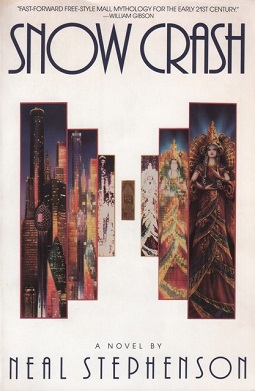 |
Snow Crash |
Snow Crash is one of the most thrilling books I've ever read, and it's not even a thriller, it's just plain ass doped up swag scifi.
This is a difficult review to write simply because I had such a blast reading this I don't even know what to say. I won't even attempt a summary that could do the plot justice, but I will say it's remarkably similar to The Spongebob Movie and it's set in the actual coolest futuristic scifi world imaginable. And they made the original developers of the Xbox read it. Nuff said. The entire experience of this is more like a movie than anything I've ever read, with its witty and enthralling and SO cinematic writing. High-octane scenes play out with words emphasized like flying bullets. Interspersed are technological jaunts complete with hacking sequences in neon green. Different points of view have vivid quirks in the language used. Cherry on top, it's even in present tense. I fucking love shit in present tense. The way the prose follows its own rules, I kept wondering what kind of experience could shape a book like this; did the author write film scripts or tech magazines? Or poetry, for that matter? Some of the overarching metaphor had me floored. I seriously fucking love the biomass theme as a foil to technology. The pervasive, universal presence of technology in this world amidst the teeming throngs of people that populate it. I will note that I got thrown off by the bit where a bunch of Sumerian religion is detailed. It felt like hitting a brick wall and I didn't read any of it for days. If your brain is enough like mine that you happen to run into this issue, IT'S OKAY, push through you WILL be able to wrap your head around where it's going for the most part and everything picks up again quickly. (In case it isn't clear, this is a poorly disguised message to myself in case I decide to reread.) I love how the author acknowledges in end notes that it was very hard to write. It's obvious that this was a monumental effort, every word felt chosen deliberately. It's not overworked either, it's like the author set out with the intent to create a masterpiece and stuck the fucking landing. There are few things I could make this statement about, but I truly appreciated that every second I spent with this. Review written June 2025. |
| Neal Stephenson | ||
| 1992 | ||
| ★★★★☆ | Favorite Quotes
Besides, interesting things happen along borders—transitions—not in the middle where everything is the same. Until a man is twenty-five, he still thinks, every so often, that under the right circumstances he could be the baddest motherfucker in the world. If I moved to a martial-arts monastery in China and studied real hard for ten years. if my family was wiped out by Colombian drug dealers and I swore myself to revenge. If I got a fatal disease, had one year to live, devoted it to wiping out street crime. If I just dropped out and devoted my life to being bad. |
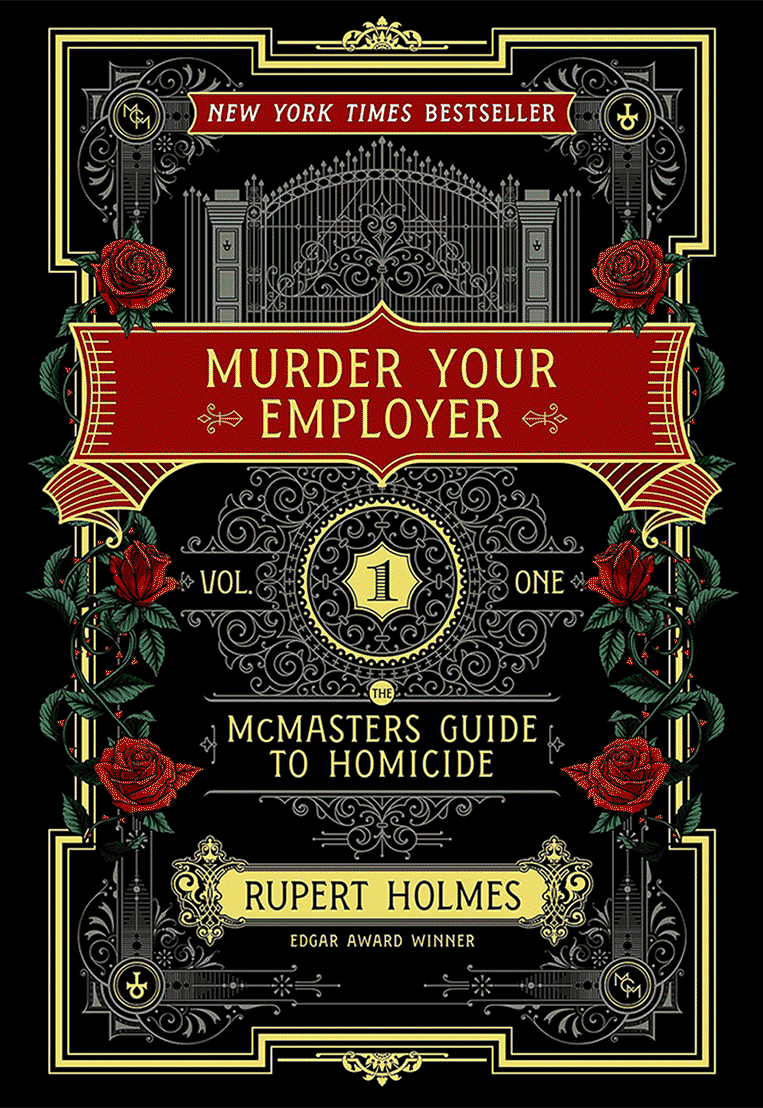 |
Murder Your Employer |
I doubt I would have picked up Murder your Employer if it hadn't been recommended to me. Blurbs about it seemed unique, but the first few pages gave me the impression it might be a denser, perhaps "quirkier" read than I wanted. Fortunately, I was surprised as things became VERY fun very early on.
We're introduced to Cliff, an aeronautical engineer whose boss cuts costs by selling unsafe designs, murders an employee who knows about this danger, and, cherry on top, blackmails a woman Cliff is interested in to the point she commits suicide. Our protagonist recognizes that this man cannot be allowed to wreak any more havoc on the world, and—you're not going to believe this—he attempts to murder his employer. Emphasis on attempts. Fortunately, his failure results in his enrollment at McMasters Conservatory for the Applied Arts, an idyllic campus where aspiring executors are tutored in the fine craft of "deleting" those who deserve it. The writing is clever and enthralling and hilarious, I did NOT want to put this down. I wasn't surprised at all to read that the author is a playwright. Maybe this background enabled the clean and clear transitions in perspective, which not only switch from character to character but from first person to third person. One thing I noticed is that there was an imbalance with two of the protagonists having a personal connection while the third is an outlier, barely a friend to either and with seemingly disparate motivations. The individual stories hold up well on their own, but this sense of distance had me expecting something would happen to bring the main characters together, which... didn't happen. Aside from that, though, the book closes in a very satisfying place. You could argue this is a spoiler-y comment, but I just want to say that I live in sunshine and rainbows world because everything wrapped up exactly the way that I hoped it would. Anyways, the instant I finished I already wished I could go back into this world. As far as escapism fantasies go... I mean, who doesn't want to be whisked off without warning to be trained by experts in a respectable craft you're actually passionate about, on an isolated campus among like-minded people? Sign me the fuck up! Review written February 2025. |
| Rupert Holmes | ||
| 2023 | ||
| ★★★★☆ | Favorite Quotes
I watched, as I suppose men have watched for centuries, to see if Gemma would give me a backward glance, and in that same rich male tradition, I admit I was vastly disappointed when she didn’t. |
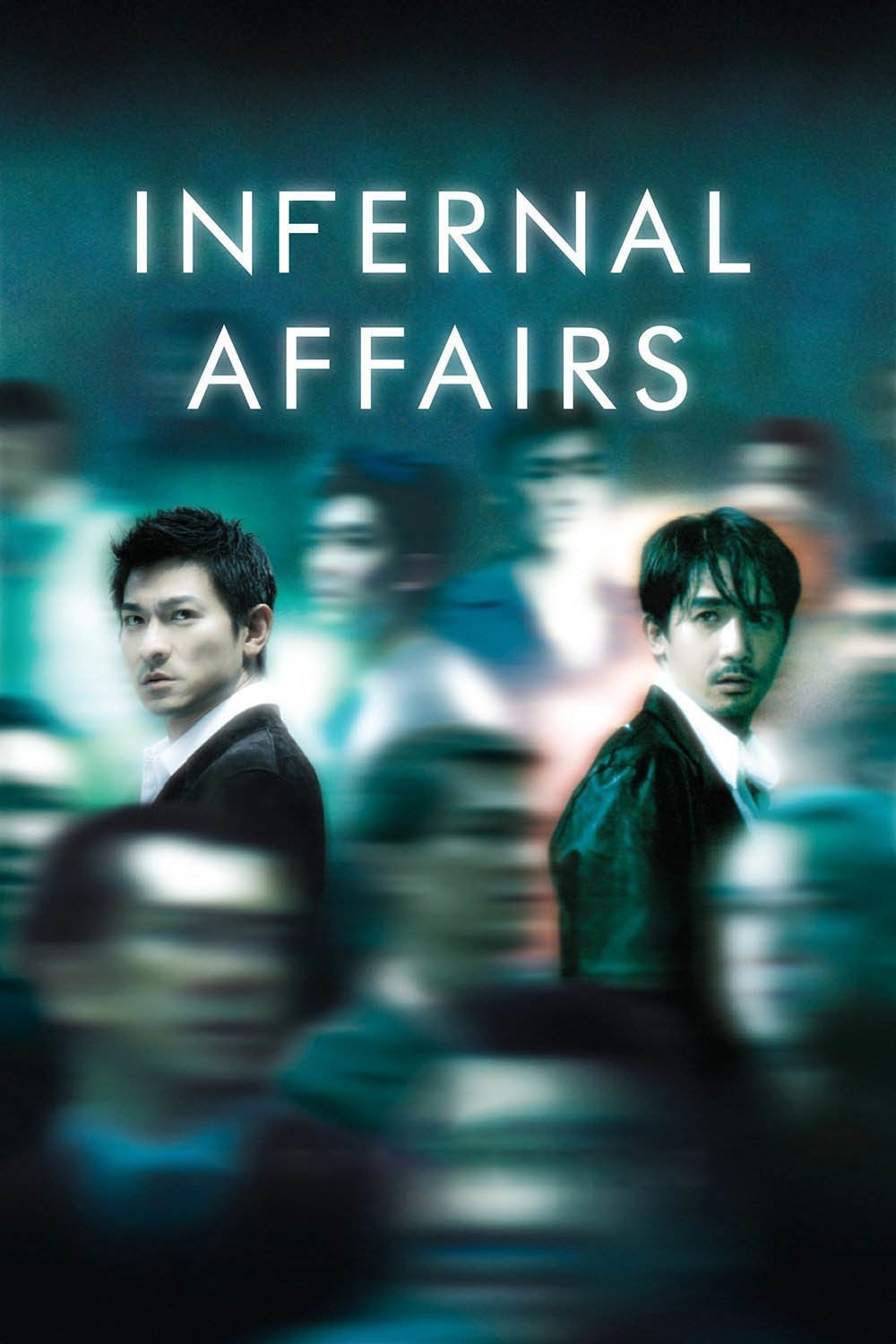 |
Infernal Affairs |
I've been on a major crime movie kick for a while now, and I started branching into foreign crime film with Infernal Affairs (無間道). It's been almost two weeks since I watched that one, and I had to get around to seeing The Departed so I could do a bit of comparison between them.
The basis of both films is that an undercover cop infiltrates the mafia while a mafia member joins the police. The two moles try to sniff each other out and drama ensues. I skimmed other reviews and there are as many opinions are there are people about whether or not the remake is actually a remake or a retelling or a totally different film with its own ~special~ place in the world. Well, in my experience, the two films are equivalent enough in main plot and even some minor details that I was bored out of my MIND for the remake's 2.5 hour runtime. Of course, length has little bearing on quality, but the earlier film tells the same story in an hour and a half, with subtlety and intricacies completely abandoned in the later film. One such finer detail is that the point of contact between the two agents is a transaction as shop employee and customer early in the film, a seemingly mundane meeting that comes into play towards the end in a satisfying show of cards. Unsurprisingly, the remake constructed the more blatant love triangle as a bridge between the two main characters, and this decision really just took the entire concept of the film down a notch in my eyes. Another distinction that really stood out to me was how much I preferred the style of the original film. I don't know much about cinematography, but the grittiness, the harsh contrast in the color grading, just felt so thematically appropriate to me. I have no idea how much camera quality, budget, and stylistic choices played into this; I don't have any context for Chinese film standards at the time. Then again, I don't know much about American movies either when it comes to the technical side of things. While it's not something that can be totally ignored, I feel that the different backgrounds of these movies had surprisingly little bearing on my impression of the two. In terms of storytelling, the original film was more finely constructed and effectively told, and this was done in a way that was more visually appealing to me than the remake. Review written February 2025. |
| Alan Mak Siu-Fai, Andrew Lau Wai-Keung | ||
| 2002 | ||
| ★★★☆☆ |
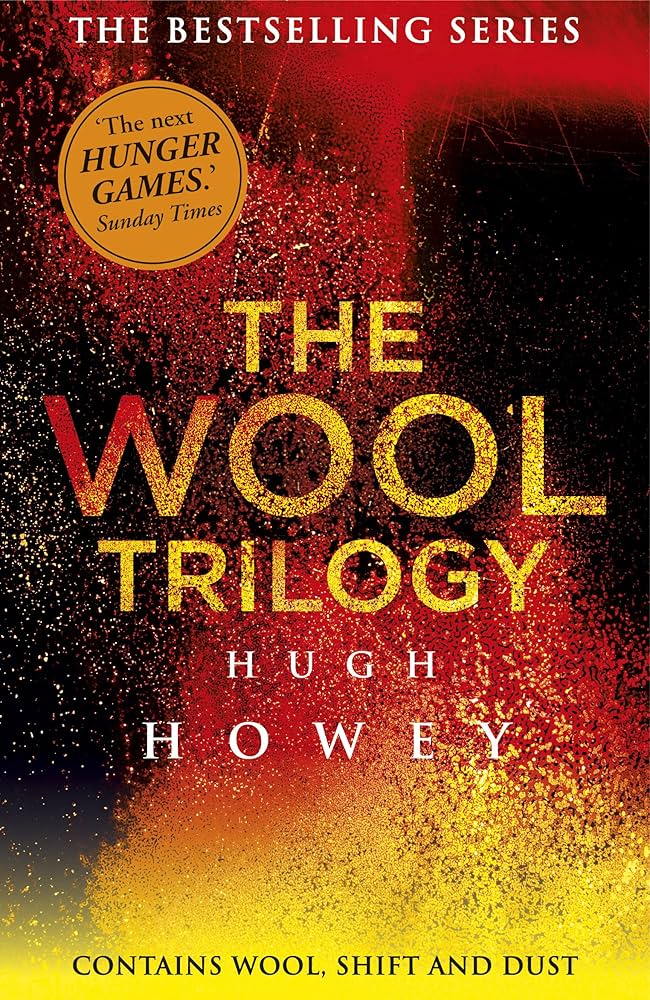 |
The Wool Trilogy |
Wow. I haven't been so glued to a novel in a looong time.
To summarize, Juliette is a mechanic working in the down deep. The generator she maintains supports electricity for the entire silo—a massive, subterranean, cylindrical society. She has no interest in the uninhabitable wasteland aboveground, but some other inhabitants of the silo harbor forbidden dreams of the outside world. Everything about this novel was for me. I was immediately taken with the writing style. It's poetic yet natural, perfectly well balanced. The way the characters speak to each other is so real. In fact, I don't think I've ever read a book before where I thought "My god, this author has so much love in their heart." There's this sense of KINDNESS, of genuine consideration, it's in the dialogue, in the characters' thoughts, in the worldbuilding, in the descriptions, it's in everything. Something like this can only be the work of an insightful and empathetic individual, an opinion of mine that was cemented when I checked out the author's online footprint. One of his most recent blog posts discusses wealth inequality in the United States, a quick scroll through his “threads” (a social media site, apparently) reveals he openly supports transgender people. The comment sections on some of his posts are inundated with socialists. This sense of worldliness leads directly into my next point, that the self-contained ecosystem of the silo is so thoughtfully constructed. I work in a bio/ag field, so I'm just a huge fan of circular systems; things like the hydroponic farms, bodies as fertilizer, the energy allocation all felt like a personal connection I had with the setting. In building this self-contained world, it was not only essential to consider all these systems that support our way of life, but to condense them. So there's this grand scale of sustaining human life underground that narrows down to a bit of circle of life, purpose on earth introspection at times. It doesn't get heavy yet, but I wonder if it will in the next book. As you might expect, untying the knots of the silo's existence takes all kinds of societal and psychological tolls on the cast. And here's the thing: all this happens so fast! I've gotten better at enjoying slow-paced things as of late, but it's so engaging when, in just the first few chapters, this world springs up around you, around these characters who drag you underground and fling you back up towards the polluted sky. I mean, not to sound like I'm sucking this Howey guy's dick too hard, but I really don't have any criticisms of Wool so far. Nothing about the story or the writing grated on my nerves or felt off. Anyways, all this to say I felt a lot of passion within this novel and in myself for the type of story being told. On to the next installation in the trilogy! Maybe I should have waited to write a review of the whole series, but I don't want to forget anything I'm thinking right now. Plus, you just never know what might happen. Review written January 2025. I really loved Wool, as you would know if you read the text up thataway ↑. Now that I've been through Shift and Dust, I'll tack on my thoughts about the trilogy as a whole. As I expected, the history of the silos builds and things start to get bureaucratic. We meet Donald, a newly elected senator. Trained as an architect, he had haphazardly designed a massive, cylindrical, self-sustaining building for a college assignment. Imagine his surprise when he's asked to redesign it to go underground. Donald, as the original designer of the silos, is obviously a key player. However, Shift switches (shifts, if you will) between his point of view and that of a young porter named Mission in a silo that is experiencing an uprising. The temporal jumps are executed well, building history in the 2040s as well as expanding the silos as they exist hundreds of years later. Unfortunately, Mission's story felt like an accessory to this overall plot of Donald and Juliette. When his tale came to a close, I felt like its only purpose was to humanize the people Donald was in a management position over; the intricacies of Mission's silo would have fared better as a side story. That's my first real complaint. Secondly, character deaths have almost no impact on... anything, really. When someone dies, no matter the circumstances, they're immediately replaced by characters who not only serve the same narrative purpose, but behave the same way. This sense of everyone being interchangeable meant that as much as I liked Juliette in the first book, I didn't think "I like this character" about anyone else. I barely thought that about Juliette by the end, if I'm being honest. The entire trilogy is just plot driven, which I think is fine, for the most part. Wool sets the stage effectively, preparing the reader for a play where the actors aren't the focus. This story of the silos would unfold no matter who the cast is. Though this approach isn't exactly a failure or mistake on the part of the author, it leaves something to be desired. And with all these meaningless deaths, the ending feels rather abrupt, as so many characters were introduced in the latter half of the last book. So, the second and third books were still pageturners for me, but they weren't up to par with the first one in many respects. With that criticism out of the way, I want to mention a very specific theme that captured me—suicide, suicidal thoughts, the so-called unbreakable human spirit at war with an innate self-destruction instinct. Lukas imagines that moment of flight before splattering a few stories down, feels "a twinge of fear and a rush of adrenalin from picturing the fall, the end, so vividly." As for another character, "part of him feared he would pass out in there and [they] would discover him dead. Part of him hoped." Jules risks death with every action she takes. Hell, even beyond mere thoughts or risks, there are more suicides in this trilogy than all the books I've read over the past year combined. Of course, maybe I'm not reading the right kind of books. Obviously, much of the hopelessness stems from coming to understand the insane circumstances of their underground lives, as opposed to existing in blissful ignorance. But they are our protagonists, so they necessarily must have a unique perspective. Anyways, this sense of despair the characters sometimes feel, instead of letting it consume them, they're driven to seek something more, to expand and improve their world. And so, it's never ever depressing. Oh, yes, it's a horrible tragedy that the land above is inhospitable. It's unfathomable how so many people have been lied to, made to believe there's nothing beyond the walls of the silo. This is a bleak, post-apocalyptic type of world, in which a deeply hopeful and joyous story spirals up and around like the central staircase of every silo. Well, that's about it. I loved the Wool trilogy, and it would be worth your time if you wanted to pick it up. Addendum written February 2025. |
| Hugh Howey | ||
| 2011, 2013, 2013 | ||
| ★★★★☆ | Favorite Quotes
Holston saw the heaven into which he’d been condemned for his simple sin of hope. ‘These buildings’ – he pointed to what looked like large white cans sitting on the ground – ‘these are silos. They hold seed for the bad times. For until the times get good again.’ The end was coming for them all. His father would laugh and disagree, [...] telling him how people had thought the same thing long before he and his brother were born, that it was the hubris of each generation to think this anew, to think that their time was special, that all things would come to an end with them. His father said it was hope that made people feel this, not dread. People talked of the end coming with barely concealed smiles. Their prayer was that when they went, they wouldn’t go alone. Their hope was that no one would have the good fortune to come after and live a happy life without them. The stains would never wash out. [...] She would always have hurt her father. Was that the way to phrase it? Always have had. It was immortal tense. A new rule of grammar. Always have had gotten friends killed. Always have had a brother die and a mother take her own life. Always have had taken that damn job as sheriff. There was no going back. |


 REVIEWS